Thursday, 6 November 2014

How Long can Hockey Survive? - The AIM Network

How Long can Hockey Survive? - The AIM Network


How Long can Hockey Survive?


hockey


For someone whose popularity was the envy of
everyone in the new Coalition government earlier this year, Joe Hockey
must be wondering what the hell happened. His pre-budget popularity
among all voters was 21 points on the positive side (51% for and 30%
against). Then came his first and possibly last budget. That budget is
best described as a fart bomb, the aroma of which just won’t go away.


From that point on Joe has suffered from a lingering case of
foot-in-mouth disease. Some of his revealing comments following on from
his earlier, ‘end of the age of entitlement’ rant, and his dancing to the ‘best day of my life’ music, on budget night, include ‘old people don’t drive cars,’ and just the other day a mind boggling, ‘we will find any way we can to take money out of universities,’ as said to Phil Coorey at the Australian Financial Review.


So, it’s pretty clear his star has hit a brick wall not just with the
electorate generally, but with LNP voters as well. The odd thing is
that Joe himself is genuinely surprised at how badly his budget has been
received. So one has to ask, did he not think that being unfair to the
disadvantaged would rebound on him? What was he thinking? Were the
unpopular budget measures his idea, or was he encouraged to go down that
path by others? Was he set up?
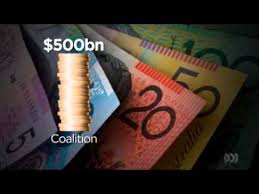


debtOne
thing is for sure. The Treasurer owns the budget no matter who else
contributed and Joe will own this one for years to come just like John
Howard owned the 1982 budget that preceded Malcolm Fraser’s defeat in
1983. The full impact of Joe Hockey’s budget is yet to be realised
because the economy is in much better shape than it was in 1982. That’s
the good news.


The government, however, campaigned furiously on fixing the ‘debt and
deficit disaster’ and that is the bad news. They did so not realising
the nature of the problem which was, and is, falling revenues and
excessive tax expenditures. They still don’t seem to realise it, or do
they? They still want to curb spending but in fact are doing the
opposite. Debt is steadily increasing. Perhaps that is why Tony Abbott
wants a more mature discussion about the GST. They know they have to
find some new money from somewhere.


Sooner or later the numbers will show them up as utter failures. They
have already left it too late. And someone will have to accept
responsibility for it. It almost feels like poetic justice that while
Peter Costello benefitted hugely from a barrel load of money coming in
from China and making him look so good, Joe Hockey’s barrel has shrunk
to a tea pot and he is looking so bad.



musicWhen the money flows the music plays. When it stops the music fades.


Costello was never put to the test. Hockey is being tested severely
right now and is not looking good at all. The analogy being, that when
things are good the music is playing. When things go pear-shaped, the
music begins to fade.


If the budget is ever to return to surplus, revenues must rise. That
is fundamental. The only way that can happen, short of a revival in
China, is to raise taxes and cut tax expenditures; the exact opposite of
Abbott’s mantra about lower taxes. They won’t do it. What a delicious
opportunity for Labor to exploit. If Bill Shorten and Chris Bowen can
climb out of their lethargic slumber and show the Coalition up for the
failures they are, Abbott will have to respond.
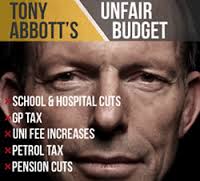


budget1The
likely response is to blame the Treasurer. That’s the way of politics.
How long has he got left? Probably one more budget and if it does
include tax increases of some description, Joe is screwed. If it
doesn’t, by 2016 the Coalition’s economic credentials will be screwed
and they will have to go.


The Coalition could have avoided all this last year by campaigning on
Labor’s leadership failures and little else, but they had to engage in
chest beating about the economy, pointing to their so called success
while Costello was Treasurer. They chose to highlight, what seemed to be
Labor’s economic failures. In reality, they shot themselves in the
foot.


They didn’t hear the music fading. In 12 to 18 months’ time the music will stop.


Like this:

Wednesday, 5 November 2014

Wounded Hockey faces a nasty choice on banks –

Wounded Hockey faces a nasty choice on banks –

Wounded Hockey faces a nasty choice on banks


The Murray Inquiry is likely to hand the government an
invitation to a fight with the big banks — and Treasurer Joe Hockey is
in no state to lead it.


Treasurer Joe Hockey managed to do it again, this week: open
his mouth and stick his foot in it. And Labor are over the moon about
it, because in doing so he has served up a line that they will quote for
the rest of the life of this troubled government.


“We’ll find any way we can to take the money out of the universities,” he told The Australian Financial Review’s Phil Coorey
yesterday, if the Senate declined to approve the government’s
slash-funding-and-deregulate-fees higher education policy. Within hours,
the Labor party had turned the statement into a poster.
The line perfectly illustrates the perception Labor has been trying to
create of the government — that it is ideological, punitive and
determined to destroy core activities voters take for granted.


Hockey has previously left open the possibility of finding
savings in other areas if the Senate refused to pass all of his
budget — a clunky statement that Labor rapidly built a scare campaign on
and which left Hockey’s colleagues wondering what he was playing at.
Now he has gone further in identifying university education as a target
and expressing a determination to do whatever it takes to slash funding.


Hockey’s statements are, on a rational level, utterly
innocuous. As Treasurer, it’s his job to manage fiscal policy in
conjunction with his Finance Minister. If savings fail to materialise,
or revenue falls short, for whatever reason, the Treasurer is the key
minister charged with determining whether they need to be offset or not,
taking into account both fiscal requirements and macroeconomic policy.
Currently — despite all the rhetoric — Hockey is running a highly
stimulatory fiscal policy, and is in no hurry to curb that stimulus,
because he knows it will undermine economic growth. But he’s also aware
that the path back to surplus will be long and challenging — longer and
more challenging than it seemed from the opposition benches — and he
will need to keep finding savings and cuts just to stick to the
long-term path he’s on, let alone move more quickly.


But politics of course is anything but rational, and Hockey
has repeatedly showed a poor grasp of how his statements will look to
voters and be exploited by the opposition. For a bloke who used to be so
popular and at ease in the media, it’s a surprising but highly
problematic flaw in his political make-up.


“A clever
Treasurer would frame the debate as being about making the banks more
responsible … A strong treasurer would lead such a debate. But “clever”
and “strong” are about the last things you’d call the Treasurer
currently.”

And it’s particularly problematic because David Murray looks
likely to dump in Hockey’s lap a particularly nasty policy problem
before the end of the year, when the Financial System Inquiry headed by
Murray reports. The inquiry is Hockey’s baby: he pushed hard for it in
opposition and, in doing so, incurred the wrath of the banking cartel,
and especially ANZ chief Mike Smith, who compared Hockey to the late
Venezuelan leader Hugo Chavez. And while the appointment of Murray as
the inquiry head, and the watered-down terms of reference, initially
appeared designed to nobble the inquiry, Murray has, at least so far,
exceeded expectations. The focus on the cartel’s capital buffers, and
the likelihood that Murray will recommend, in some form, an increase in
the requirements for the big banks to hold assets against lending, means
a stoush is looming between the government and the cartel.


The increase in capital requirements serves two
purposes — to strengthen the banks in the face of future financial
crises (and there will be future financial crises, because that’s
capitalism) and to resolve the “too big to fail” dilemma whereby the
likes of Mike Smith use the fact that no one seriously doubts the
government would intervene to prop up the big four, in order to fund
riskier activities in other markets and see off competition from smaller
banks locally.


But the banks are already engaged in preemptive blackmail,
warning that any increase in capital reserve requirements will curb
lending, send interest rates soaring and, in Smith’s words,
“come at a cost to the economy through lower growth, fewer jobs and
lower tax revenue”. That is, the usual Four Horsemen of the Apocalypse
stuff from an industry facing regulation or higher taxes. No mention,
naturally, of the lower economic growth that comes from having a banking
cartel at the centre of our financial and wealth management systems.


But the cartel isn’t just another industry. Even more so
than the mining industry, this is a sector accustomed to getting its way
with governments. The Coalition has already demonstrated its
willingness to go to the wall for the cartel, restoring conflicted
remuneration to the retail super sector controlled by the cartel and
AMP. Murray’s expected recommendations (note that the Australian Prudential Regulatory Authority
this morning released its new residential mortgage lending
requirements, which will need to be digested first) will leave the
government, and Hockey, in an invidious position. It will need to either
ignore its hand-picked review panel on an issue where, outside the
cartel, there is widespread agreement about the need to fix “too big to
fail”, or have a stoush with a key ally.


Neither is a good outcome for a politically wounded Hockey. A
clever Treasurer would frame the debate as being about making the
banks, currently bringing in record profits, more responsible in the
face of future threats, and less likely to call on taxpayers. A strong
treasurer would lead such a debate. But “clever” and “strong” are about
the last things you’d call the Treasurer currently. Perhaps Hockey will
spend the next few months “considering” the inquiry’s recommendations in
the hope that, between now and the middle of 2015 (Hockey being too
busy preparing MYEFO and next year’s budget to fully focus on it before
then), something will turn up. Namely, his political touch.


Monday, 13 October 2014

'Absolutely ridiculous': Joe Hockey denies Australia is dirtiest greenhouse gas emitter in OECD

'Absolutely ridiculous': Joe Hockey denies Australia is dirtiest greenhouse gas emitter in OECD

'Absolutely ridiculous': Joe Hockey denies Australia is dirtiest greenhouse gas emitter in OECD


Date

Gareth Hutchens and Latika Bourke


Hockey grilled on BBC

Treasurer Joe Hockey has been
bombarded with questions on climate change, the economy and Australia's
relationship with China during an interview on the BBC World News airing
at 2:30pm and 7.30pm on Tuesday.
    Treasurer Joe Hockey has denied that Australia is the highest
    greenhouse gas emitting country in the OECD per capita, telling a
    British journalist the statement is "absolutely ridiculous".


    He has also refused to explicitly back the democracy movement
    in Hong Kong, and says Australia's free trade negotiations with China
    will not be damaged by China's shock move last week to introduce new
    tariffs on imports of Australian coal.


    On his first trip to London since becoming treasurer, Mr
    Hockey has also told an audience at the Institute of Economic Affairs
    that Australia's Reserve Bank has only a "limited capacity" to stimulate
    economic growth and Australia can no longer afford a "she'll be right"
    approach if it wants to avoid recession or high unemployment.


    Joe Hockey, currently on a tour of the US and the UK, has rejected claims Australia is "one of the dirtiest most greenhouse gas-emitting countries in OECD".
    Joe Hockey, currently on a tour of the US and the UK,
    has rejected claims Australia is "one of the dirtiest most greenhouse
    gas-emitting countries in OECD". Photo: AP


    On the BBC's Hardtalk program recorded overnight, Mr Hockey faced tough questions about Prime Minister Tony Abbott's views on coal, Clive Palmer's recent explosive appearance on the ABC's Q&A
    during which he called the Chinese government "mongrels who shoot their
    own people," and Labor leader Bill Shorten's criticism that Australia
    is now seen as the climate change sceptic capital of the world.


    He told BBC host Stephen Sackur that Europeans had a
    "fundamental misunderstanding" of Australia's economic ties with Asia,
    particularly China, and the view that Australia had a "massive reliance
    and dependence" on China for exports was a "complete misread".


    He also laughed at the suggestion that Australia was "one of
    the dirtiest most greenhouse gas-emitting countries in OECD group of
    developed countries".


    "The comment you just made is absolutely ridiculous," Mr Hockey told Sackur.


    "We've got a small population and very large land mass and we
    are an exporter of energy, so that measurement is a falsehood in a
    sense because it does not properly reflect exactly what our economy is,"
    Mr Hockey said.


    "Australia is a significant exporter of energy and, in fact,
    when it comes to coal we produce some of the cleanest coal, if that term
    can be used, the cleanest coal in the world."


    His comments contradict the Garnaut Climate Change Review, which says Australia was the highest per capita emitter of greenhouse gas emissions in the OECD, even without exports of energy.


    "Australia's per capita greenhouse gas emissions are the
    highest of any OECD country and are among the highest in the world," the
    review says.


    "Australia's per capita emissions are nearly twice the OECD average and more than four times the world average."


    When asked on the BBC program, which will air in full on BBC
    World News on Tuesday evening, about China's surprise decision last week
    to introduce 3 per cent and 6 per cent tariffs on coal imports, Mr
    Hockey said Australia had no political problem with China at the moment.


    But he would not say if negotiations with China on a free
    trade agreement would end if there was no agreement by the end of this
    year.


    Mr Hockey also avoided explicitly backing the democracy
    movement in Hong Kong, saying only that it was "fair comment" that the
    Chinese must let genuine democracy reign there.


    At a different event, Mr Hockey told an audience at the
    Institute of Economic Affairs that the Reserve Bank has only a "limited
    capacity" to stimulate economic growth.


    He also said sustained low interest rates had seen wealthier Australians who own assets become wealthier.


    Reviving his infamous Age of Entitlement speech, which he
    gave to the same organisation in 2012, Mr Hockey said the crux of his
    speech - that governments cannot keep borrowing money from future
    citizens to pay for today's entitlements -  "remains a self-evident
    truth".


    But he said it requires "difficult and consistent decision making" and "a fair measure of bipartisan support". 


    Mr Hockey has been strongly criticised in recent days for suggesting Labor leader Bill Shorten should commit to backing stalled separate budget measures to help pay for the Iraq mission, if Labor is "honest" about its bipartisan support.   


    But Prime Minister Tony Abbott has refused to endorse his
    Treasurer's call and instead described opposition leader Bill Shorten as
    a "patriot".


    Follow us on Twitter


    Sunday, 12 October 2014

    When Joe Hockey talks, Coalition colleagues wince

    When Joe Hockey talks, Coalition colleagues wince

    When Joe Hockey talks, Coalition colleagues wince


    Australian Federal Treasurer Joe Hockey. Picture: Stuart Ramson
    Australian Federal Treasurer Joe Hockey. Picture: Stuart Ramson


    HICCUP Hockey strikes again! Just when colleagues were starting to
    think the Treasurer might be getting his act together he produces
    another gaffe.


    Joe Hockey’s attempt to use national security to pressure Labor over his stalled Budget Bills was an appalling misjudgement.

    The
    Government has been at pains to secure a bipartisan approach to
    military action against IS abroad and the threat of terrorism at home.
    Opposition Leader Bill Shorten has provided the solid support Tony
    Abbott wants.


    Then along comes Hockey, foot in mouth at a news conference in Washington, and puts that at risk.

    “If
    Bill Shorten truly is honest about his commitment to deliver bipartisan
    support in relation to our defence efforts in the Middle East, he’ll
    provide bipartisan support to pay for it,” he said.


    The alacrity
    with which the Prime Minister hit the airwaves to declare Shorten “an
    Australian patriot” showed how seriously he viewed Hockey’s lapse.


    Shorten’s response was to express disappointment that the Treasurer
    had “made the Iraq intervention a source of political point-scoring”.


    To quote Abbott’s close friend, Greg Sheridan, foreign editor of The Australian:
    “The most sure-fire way for a government to make a mess of the politics
    and, incidentally, the national security issues themselves, is to look
    as if it is milking national security for party-political advantage.”


    Abbott
    knows his task would be harder, and a lot more perilous politically,
    without Shorten on side. He also understands that bipartisan support is
    important for the morale of the Air Force personnel and SAS troops he is
    sending into harm’s way.


    Friends say Abbott recalls vividly what
    happened when Australian forces were committed to the 2003 Iraq invasion
    without such bipartisanship. Departing troops were jointly farewelled
    by then prime minister John Howard and Opposition leader Simon Crean.
    But the message from Crean was that, while Labor supported them, it did
    not support their mission.


    Hockey, a very experienced politician
    and would-be leader, should know all that. Small wonder that even some
    Liberals once close to him are starting to talk about Abbott’s “Hockey
    problem”.


    Since IS atrocities and the domestic terrorism threat
    began to dominate the news, the Treasurer has been less on display than
    he was in the three months following the Budget.


    There was an
    incident a couple of weeks ago when deputy Liberal leader and Foreign
    Affairs Minister Julie Bishop had to slap him down publicly over
    suggestions that he was considering a further freeze on foreign aid.


    But
    for the most part, Hockey thought bubbles have been absent from the
    headlines. That gave Coalition MPs reason to hope that the Treasurer had
    regained some self-discipline and was quietly working to rebuild
    credibility.


    After all, Hockey has plenty of incentive to try to
    lift his game. As a politician with a burning ambition to become prime
    minister — just read his biography if you doubt that — he must be
    dismayed by the way his standing and reputation have crumbled.


    It
    is generally agreed that the Treasurer has gone from heir apparent to
    liability. Liberal MPs, watching him now, must thank their lucky stars
    that the plan to make him leader in 2009 came unstuck.


    An added
    reason for relief should be the recollection that Hockey’s election to
    the leadership would have seen Julie Bishop dumped as deputy Liberal
    leader.


    In contrast to Hockey, Bishop has emerged as one of the
    strongest performers in the Abbott Cabinet. The deputy on Hockey’s
    ticket was Peter Dutton.


    There is plenty of discussion within the
    Government about Hockey’s prolonged period of poor form. Explanations
    range from sloppiness in his approach to poor political advice from
    staff.


    “People know he’s capable of doing a lot better,” says a
    Coalition adviser. But a former minister claims: “He was never regarded
    as part of the A team under Howard.”


    THERE is no disagreement,
    however, about the serious implications for any government if a
    treasurer is underperforming. According to a senior figure in the
    Liberal organisation: “Tony needs to address this. The Treasurer is the
    second-most important person in the Government. It can’t go on.”


    He
    is not suggesting Hockey be moved from the portfolio. Rather, he says,
    the Prime Minister “should perhaps involve himself more with Joe” so
    that he can “keep an eye on things”.


    Whether a busy PM has time to nursemaid a Treasurer, however, is doubtful.

    Another
    proposal doing the rounds is to lighten the Treasurer’s workload by
    hiving off some of his less important areas of responsibility and giving
    them to another minister.


    Ultimately, though, the only person who
    can fix the situation is Hockey himself. The obvious starting point is
    for him to think more carefully about what he says before he says it.


    Laurie Oakes is the Nine Network political editor


    Comments

    Thursday, 9 October 2014

    How to pay for a war - The AIM Network

    How to pay for a war - The AIM Network


    How to pay for a war


    The Treasurer said if Mr Shorten was “honest” about his promise of
    bi-partisan support for Australia’s mission in Iraq, he would pass
    budget measures currently stalled in Parliament.  Is he suggesting
    that sick people, pensioners, students and the unemployed should fund
    the war?


    I have a suggestion.


    When Joe Hockey produced his first fiscal statement in December last
    year, the deficit over the forward estimates had grown from $54.6
    billion in August’s PEFO to $123 billion.


    Part of this was due to Joe spending an extra $11 billion in his
    first 100 days as Treasurer, the most significant payment being the
    unasked for $8.8 billion gift to the RBA.


    But the greatest increases to the deficit (and future debt) came from
    just changing forecasts. Hockey told us that Labor’s predicitions were
    unrealistically optimistic, despite the independent PEFO coming up with
    the same figures.


    In almost every parameter, Hockey lowered PEFO forecasts, often
    dramatically, for the performance of the Australian economy . He
    insisted on the worst possible forecasts in order to exaggerate the
    “mess” he inherited.


    Real GDP forecasts from PEFO were 2.5% and 3%, written down in MYEFO to 2.5% and 2.5% for the years 2013-14 and 2014-15.


    The quarterly national accounts figures show the trend annual real
    GDP growth of 3.2% which is right on the 25-year average and
    significantly higher than predicted in either PEFO or MYEFO.


    The IMF expects the Australian economy to grow by 2.8 per cent in 2014 and 2.9 per cent in 2015.


    As for nominal GDP, PEFO predicted 3.75% and 4.5% – Hockey’s MYEFO 3.5% and 3.5%.


    He decreased nominal GDP forecasts to their lowest level since the
    global financial crisis. This has a massive impact on revenues, which
    are very sensitive to changes in nominal GDP growth. This had the effect
    of reducing projected revenue over the forward estimates to $51 billion
    less than projected in PEFO.


    In fact our annual nominal GDP rose by 4%. This is less than the
    25-year average of 6.1% but once again, significantly higher than
    predicted by Hockey and even higher than PEFO.


    Joe’s predictions about construction were even worse.


    In MYEFO, housing construction growth was reduced to only 3% rather than 5% as forecast in PEFO.


    Private dwelling investment actually increased 3.2% in the June
    quarter and 9.5% in the past year, the strongest pace of growth recorded
    in the Housing Industry Association Performance of Construction Index
    nine-year history.


    As these few examples have shown, and as was muttered at the time (or
    shouted loudly by some of us), Hockey’s predictions were unnecessarily
    pessimistic in an obvious attempt to artificially create the debt and
    deficit disaster you have when you aren’t having a debt and deficit
    disaster.


    Change a couple of assumptions and hey presto, we’re rolling in money. Bombs away.


    Speaking of which, did you hear that the ADF just threw away $400 million worth of missiles that don’t fit their new planes?


    You wanna talk waste, start with a group who plan that badly.


    Saturday, 27 September 2014

    Has the Government doubled the budget deficit?


    Chris Bowen says Joe Hockey has doubled the deficit by changes to
    Government spending and changes to Government assumptions. ABC Fact
    Check finds his claim checks out. Read more here: http://www.abc.net.au/news/2014-05-06...


    Tuesday, 19 August 2014

    An Open Letter to Joe Hockey - » The Australian Independent Media Network

    An Open Letter to Joe Hockey - » The Australian Independent Media Network


    An Open Letter to Joe Hockey


    Dear Joe Hockey,


    Back in 2012, when you said the age of entitlement was over, I was so relieved. I was relieved that highly-paid politicians like Tony Abbott would no longer think it acceptable to charge tax-payers for personal book tours. I was relieved that filthy rich politicians like Malcolm Turnbull, and like yourself,
    would put an end to ethically-suspect rental schemes, where your
    tax-payer funded Canberra housing allowance is paid to your spouses for
    investment properties they have cleverly put in their names. Which you
    will no doubt benefit from once again when they sell. I was also
    relieved to hear that this sense of entitlement would also be finished
    for the families of rich politicians, when the likes of Tony Abbott
    would say it was not acceptable to accept a secret scholarship for his
    daughter’s education. Nor a refund on a non-refundable deposit
    paid on a rented flat without proper due diligence that any other
    non-entitled member of the public is in no position to demand. Nor lavish trips to the Melbourne Cup
    to hob-knob with celebrities which even you can no doubt see is not in
    the public interest and therefore not an entitlement that should be
    charged to the tax-payer. Because these are the best examples I have
    ever seen of a sense of entitlement which is so entrenched and seemingly
    innate that it’s like an incurable disease that seems to have no end.
    So again, congratulations on declaring an end to it.


    And oh how I wish I could leave this letter here. But I can’t. And
    you know why I can’t. Because I am mistaken. I am not mistaken that you
    wish to end the age of entitlement. What is clear is that you do in fact
    want to end what you call entitlement. The problem is, your
    definition of the problem of entitlement in our culture, and my
    definition, are completely different things. From the budget you’ve
    handed down, and from your recent statements about poor people’s spending habits on petrol (which no one misinterpreted, you really should own your mistakes Joe), it’s clear that you think entitlement is our community’s idea of rights.
    Rights to quality education. Rights to quality healthcare. Rights to a
    clean and sustainable environment. Rights to a social safety net when
    things go wrong. Rights to live in a community where it’s possible to be
    born poor, but to better our circumstances through hard work,
    encouragement and support from those around us. All these rights are
    what you call ‘a sense of entitlement’ aren’t they Joe? And aren’t these
    rights the things you would ideally like to end? Isn’t your budget,
    built on a foundation of lies about a non-existent budget-emergency,
    your campaign to kill the very culture that provides Australians with
    rights to all of these things that any first-world, educated,
    well-resourced and fair country like Australia should strive to protect?
    Isn’t your end of the age of entitlement just code for a user-pays
    capitalist small-government, tax-free wonder-land?


    Well, had I known you meant to end this definition of
    entitlement, I would never have felt relief. You need a reality check
    Joe. Rights are not entitlements. And someone like you, with your family
    background, would surely understand this if you ever cared to think
    about it, perhaps while you’re enjoying a quiet sit and a cigar. On the
    profile on your website, you have published this:“Joe
    Hockey was born in North Sydney, as the youngest of four children. His
    father was born in Bethlehem of Armenian and Palestinian parentage and
    his Mum in Chatswood. His family worked hard running a small business on
    the North Shore, beginning with a deli in Chatswood and later, a real
    estate agency in Naremburn.”
    So you like to portray your family
    story as the classic ‘we pulled ourselves up from the bootstraps’ tale
    of social mobility. And like so many who have come before you having
    found riches and success in your careers, you now seem hell bent on
    destroying mobility for others by burning the ladder of opportunity that
    you climbed to the top. And that’s what you really meant when you said
    it is time to end the age of entitlement.


    You’ve got it so wrong Joe. Social mobility is not an entitlement.
    Access to social mobility is a right. And it’s a right Australians will,
    when they wake up to you, fight to save. You and your rich Liberal
    Party chums portray the true meaning of entitlement through your little
    glass tower of privilege where you think it’s ok to simultaneously reap
    the rewards of tax-payer funded wealth, while destroying the rights of
    the community by wrecking the public policies designed to keep the
    playing field level. Shame on you Joe. Shame on you and your entitled
    Liberal government.


    Yours Sincerely


    Victoria Rollison


    JOE HOCKEY YOU CANNOT SQUIRM YOUR WAY OUT OF YOUR WORDS.
    DON’T SAY NOW THAT YOU WERE MISINTERPRETED.

    Click on link to view video
    https://vine.co/v/MYH9MiYZgaZ


    Monday, 18 August 2014

    Deficit size fetishism: Why Joe Hockey needs to learn economics

    Deficit size fetishism: Why Joe Hockey needs to learn economics


    0


    (Image via georgebludger / Flickr)


    Treasurer Joe Hockey – and many other treasurer's in
    developed countries – have a poor grasp of economics,
    wrongly conflating national fiscal policy with running a household
    budget. UNSW Professor Geoff Harcourt explains (via The Conversation).


    THOUGH MONEY AND FINANCIAL FACTORS are integrated in complex ways in
    the workings of the economy, ultimately it is real resources – work
    forces (sizes and skills), capital goods and natural resources – that
    set the upper limit at any moment of time on the size of the community’s
    standard of living.


    And yet that hasn’t stopped successive Australian Federal treasurers
    – along with their counterparts in other advanced capitalist economies
    – increasingly using terms which reflect misunderstandings of the role
    of fiscal policy in economic policy.


    When used by treasurers, phrases such as “we cannot afford it
    financially” or “where is the money to come from?” or “you are using
    taxpayers’ money”, confuse affairs of the state with what should be left
    to the workings of individual households.


    Obsessed with the relationship of government expenditure and
    taxation, many treasurers suffer from deficit size fetishism, and fall
    victim to the “balancing the budget over the cycle” fallacy. Many also
    get caught up with hypothecation — matching specific government
    expenditures with particular tax sources.


    Some confuse the significance of the national debt to income ratio
    for the present and future operations of the overall economy, especially
    the supposed link between them and the welfare of future generations
    relative to the welfare of the present generation. The “we’ll all be
    ruined” fear.


    Deficit obsession


    “Deficit size fetishism” reflects the view that government
    expenditure and taxation are always “bad”, regardless of the absolute
    sizes and compositions of the two and the overall state of the economy
    — for example, the rate of unemployment, the rate of growth, the rate of
    inflation (or deflation, as Japan has experienced in recent decades).
    Both the sizes and compositions of government expenditure and taxation
    need to be assessed by other criteria.


    The composition of taxation, the contributions to the whole of
    indirect, direct and other forms of taxation, and their incidence on
    different groups in the community, ought to reflect equity (fairness)
    — such as which groups can least or most afford to pay particular forms
    of tax and taxes overall.


    The total tax take should reflect the impact required on overall
    levels of spending in the economy, these in turn determining the levels
    of output, income and employment both prevailing and what the government
    would like to see prevail.


    Spending and borrowing


    The composition of government expenditure is made up, first, of
    current expenditures — the salaries of parliamentarians, public servants
    and government employees, generally; transfer payments from taxpayers
    to recipients of social services, such as unemployment benefits, old-age
    pensions and so on; and interest payments to domestic holders of
    government bonds.


    Secondly, there is government (public) capital expenditures on social
    infrastructure — the creation of new railways, roads, hospitals,
    schools and so on. Ideally, the level and composition of capital
    expenditure should be determined by the perceived medium to long-term
    needs of the community for the services they ultimately will provide.


    As these expenditures have a significant impact on the efficiency and
    productivity of the nation, there is no reason why they should not be
    financed at least in part by borrowing, even by borrowing from overseas.
    The latter does entail a real burden because interest and principal
    repayments mean higher levels than otherwise of exports to service them
    would be required. Nevertheless, if the borrowings are used wisely, this
    burden may be met and the economy still be better off than it otherwise
    would have been.


    There is no equivalent burden associated with internal debt (owed to
    lenders within the country) for, as noted, this involves a transfer from
    taxes to interest payments. The impact on overall demand depends upon
    the differences in the consumption and saving behaviour between
    taxpayers, on the one hand, and interest receivers, on the other. They
    may, of course, overlap. Any fairness considerations associated with
    such transfers may be tackled through the composition of the structure
    of tax rates.


    So government expenditure and taxation, especially taken in
    isolation, are not interesting numbers. Certainly not numbers to have a
    fetish about, even if you are not just an ordinary Joe, or an earthbound
    Swan, or a surplus lover Costello that hands out tax cuts to friends.


    The criterion of balancing the budget over the cycle – or,
    preferably, creating a surplus – is based on a fallacy that the economy
    is not growing, that it will remain at the same level of activity
    forever. At least since the 1940s, it has been known that if economies
    on average grow from cycle to cycle. Thus, it is possible always to have
    deficits (within reasonable limits) without annual deficits exploding;
    for specific rates of growth, the deficit approaches particular limiting
    values that are livable within a wide range of values.


    The real tax and spending relationship


    One outcome of this discussion is that hypothecation is a fallacy —
    particular forms and amounts of taxes should not be attached to
    particular forms of expenditure.


    Citizens should pay taxes according to their overall ability to pay
    and they should receive government payments according to their
    particular characteristics as citizens — unemployed, aged, disabled and
    so on. The total of these government expenditures will be financed from
    the total funds raised by taxation and borrowing.


    “Treasurer Speak” in recent decades reflects serious conceptual
    misunderstandings of how economies work and how the functions of the
    state should be integrated with the workings of the private sector.


    The end result has been the use of scare tactics over a wide range of
    issues, tactics which have no foundation in proper economic logic.


    The ConversationGeoff Harcourt is a member of the ALP. This article was originally published on The Conversation. Read the original article.


    Friday, 15 August 2014

    'I'm very sorry': Joe Hockey apologises for comments about poorer people not driving cars

    'I'm very sorry': Joe Hockey apologises for comments about poorer people not driving cars

    'I'm very sorry': Joe Hockey apologises for comments about poorer people not driving cars


    'I am really, genuinely sorry': Hockey

    The Treasurer has gone on radio to
    apologise for suggesting the “poorest people either don't have cars or
    actually don't drive very far”.
    Treasurer Joe Hockey has delivered a grovelling apology for
    suggesting the “poorest people either don't have cars or actually don't
    drive very far” and that the government’s proposed fuel excise increase
    was a progressive tax measure.


    Mr Hockey used the words "sorry" and "apologise" eight times
    in an interview with his close friend and 2GB broadcaster Ben Fordham
    on Friday.


    Joe Hockey appears on 2GB on Friday to apologise for his comments.
    Joe Hockey appears on 2GB on Friday to apologise for his comments. Photo: @BenFordham


    He said: “I am really genuinely sorry that there is any
    suggestion, any suggestion at all that I or the government does not care
    for the most disadvantaged in the community.”


    Mr Hockey had initially stood by the comments he had made on Brisbane radio on Wednesday, stating he was sorry if they had been callous but insisting he had statistical evidence on his side.


    But in an embarrassing rebuke for the Treasurer, Prime Minister Tony Abbott said on Friday that “Well plainly, I wouldn't say that" before adding the Treasurer had his full support.


    <em>Illustration: John Shakespeare</em>
    Illustration: John Shakespeare


    Senior front bench colleague Christopher Pyne also said on Friday that Mr Hockey had his “full support”, but then declined six times to back Mr Hockey's inflammatory comments.


    After 48 hours of criticism from his colleagues, the
    opposition, the welfare and economists, Mr Hockey completely withdrew
    his earlier comments.


    “I’m sorry about the interpretation,  I am sorry about the words," he said.


    “All of my life I have fought for and tried to help the most disadvantaged people in the community.


    "For there to be some suggestion that I have evil in my heart
    when it comes to the most disadvantaged people in the community is
    upsetting.


    "But it’s more upsetting for those people in the community.
    So I want to make it perfectly clear to the community that if there’s
    any suggestion that I don’t care about you or that I have evil intent
    toward you, I want to say that couldn’t be further from the truth and
    I’m sorry for the hurt."


    Mr Hockey conceded that his government’s message about the need for budget repair had been lost because of his misstep.


    “We are trying to deliver a plan for the nation that ensures
    that those most disadvantaged get the very best we as a community can
    offer. I’m trying to make the healthcare system sustainable, I’m trying
    to make the welfare system sustainable and the education system the best
    it can be,’’ he said.


    “You can only do that through what we are trying to do in the budget but it has been lost in the last few days and I’m sorry.”


    “My feelings on this don’t matter, I don’t want to be in a 
    position where I am upsetting the most disadvantaged people in the
    community because I am trying to everything I can, the government is
    trying to do everything it can to help those people.”


    "In the case of fuel excise, I am sorry the words came out
    like they did but we are trying to lay down the best road program that
    helps families, the most disadvantaged, that helps lift the economy and
    create jobs, we can only pay that with an increase in the fuel excise of
    on average 40c a week,’’ he said.


    “But it has been lost over the last few days and I’m sorry about that.”


    Mr Hockey said he wanted to get on with the job of explaining
    to Australians the Coalition government was focused on building a more
    prosperous and caring nation.


    "What has been said can't be unsaid. I can only apologise for any hurt I have caused."


    The Treasurer said he had not been asked to make the appearance or the apology.


    ‘‘I thought about it this morning and I thought I don’t want to hurt people and the words were clearly hurting some people.”


    Follow us on Twitter


    Poll: Do you accept Joe Hockey's apology for his comments about the fuel levy increase and the poorest not owning cars?


    Yes, let's move on
    14%
    No, too little too late
    86%
    Total votes: 11031.


    Poll closed 15 Aug, 2014


    Disclaimer:

    These polls are not scientific and reflect the opinion only of visitors who have chosen to participate.


    Thursday, 14 August 2014

    Liberals attack Joe Hockey

    Liberals attack Joe Hockey

    Liberals attack Joe Hockey


    Date
    • 47 reading now

    James Massola


    Hockey backlash grows

    Labor, the Greens and
    crossbenchers have taken the Treasurer to task for his comments about
    low income earners, but Joe Hockey has defended the comments.
    Joe Hockey's colleagues and political allies have rounded on
    the Treasurer, questioning his judgment and the quality of advice he is
    receiving after a disastrous gaffe suggesting poor people ''don't have
    cars or actually don't drive very far''.


    Mr Hockey has lost three key staff from his 17-person office
    in the nine months since the federal election. They include the second
    and third most senior people in the office, who have left since the
    budget and were charged with overseeing the budget process and providing
    crucial political and economic advice.


    Fairfax Media contacted more than a dozen of Mr Hockey's
    supporters in the ministry and party machine; political staff; and staff
    to former treasurer Peter Costello on Thursday about this week's gaffe.
    All expressed surprise, concern and dismay about Mr Hockey's remarks.


    Ron Tandberg
    Illustration: Ron Tandberg


    Furious ministerial colleagues turned on the Treasurer over
    comments they variously described as ''stupid and wrong'', a ''bad
    example of how to make a point'' and ''loose language''.


    Several people close to Mr Hockey's office, who asked not to
    be named, said he was taking advice from an increasingly small circle of
    advisers - particularly chief of staff Grant Lovett and press secretary
    Mike Willesee.


    The loss of the experienced trio of deputy chief of staff
    Creina Chapman, who moved to the corporate sector soon after overseeing
    the first budget; economics adviser Tony Pearson, who took a sabbatical;
    and media adviser Tony Ritchie, who joined the NSW Police media team,
    suggested power was increasingly concentrated in the hands of too few
    people.


    <em>Illustration: Cathy Wilcox</em>
    Illustration: Cathy Wilcox


    One observer suggested the office "lacked direction", and that Mr Hockey lacked an adviser with ''a hard political edge''.


    ''Joe is freelancing, being dumb with his words, though it's not Rudd office dysfunction,'' the source said.


    A second observer said Mr Hockey ''could probably strengthen
    his office'', adding the Treasurer needed a political adviser in the
    mould of David Gazzard, the hard-nosed former political adviser to Mr
    Costello.


    Mr Hockey's gaffe has capped a difficult three months in
    which the Treasurer has been under fire for puffing on a cigar and, days
    later, dancing with his son on budget night before delivering
    wide-ranging budget cuts, taking a holiday to Fiji during a key
    parliamentary sitting, complaining that everyone in the media was
    against him and co-operating with a biography that revealed he wanted
    an even tougher budget.


    The North Sydney MP went on a radio blitz on Thursday in an attempt to limit the fallout from the gaffe.


    ''The fact of the matter is that I can only get the facts out
    there and explain the facts; how people interpret them is up to them,''
    he told Fairfax Radio station 2UE.


    Asked if he realised if his comments sounded callous, Mr
    Hockey said: ''I'm sorry if that's the case but the fact is that the
    Labor Party says that it's an unjust initiative, unfair initiative,
    higher income people aren't paying enough, well here is an initiative
    where higher income people pay on average three times the amount of
    lower income households in the fuel excise,'' he said.


    Mr Hockey's claim that higher-income households pay more in
    fuel tax is correct in absolute terms but the claim the tax is
    progressive has been debunked by research from the Parliamentary
    Library, the Grattan Institute and consumer group One Big Switch that
    shows poorer people spend a higher proportion of their income on fuel.


    South Australian Liberal Cory Bernardi said the Treasurer's comments were a ''distraction'' and ''we don't need distractions''.


    ''Those in the lower socio-economic group tend to spend more,
    as a percentage of their income, on transport and the basic necessities
    of life than do those who are wealthier."


    Queensland Liberals Teresa Gambaro and Ian MacDonald and NSW
    Nationals senator John Williams also took thinly veiled swipes at the
    comments.


    The federal opposition used the three-month anniversary of
    Mr Hockey's unpopular first budget, much of which remains blocked by the
    Senate, to step up its political attack on the Treasurer. Treasury
    spokesman Chris Bowen labelled the comments ''insulting to the
    intelligence of the Australian people''.


    With Latika Bourke

    Read more: http://www.smh.com.au/federal-politics/political-news/liberals-attack-joe-hockey-20140814-3dpoj.html#ixzz3AOSZVypk